Tuesday, October 25, 2011

The Lake by Edgar Allan Poe


In spring of youth it was my lot
To haunt of the wide world a spot
The which I could not love the less -
So lovely was the loneliness
Of a wild lake, with black rock bound,
And the tall pines that towered around.

But when the Night had thrown her pall
Upon that spot, as upon all,
And the mystic wind went by
Murmuring in melody -
Then - ah then I would awake
To the terror of the lone lake.

Yet that terror was not fright,
But a tremulous delight -
A feeling not the jewelled mine
Could teach or bribe me to define -
Nor Love- although the Love were thine.

Death was in that poisonous wave,
And in its gulf a fitting grave
For him who thence could solace bring
To his lone imagining -
Whose solitary soul could make
An Eden of that dim lake.


Wednesday, October 19, 2011

More Sophie Stories

This post is another Sophie, my cat, story. She turned one - year - old in August, she's no longer a kitten so when she's naughty it's no longer as "cute" as it once was. I've had cats in my life for 50 years, but never one as "challenging" as Sophie. She is very smart, understands a lot of commands and better than most cats, she actually obeys  me - some of the time. She loves to climb everywhere. If she's awake, she's climbing. She is also the clumsiest cat I have ever shared my home with. She will climb up on top of the kitchen cabinets over the refrigerator and frequently curl up in one of my baskets. Occasionally she will get the basket rocking around and several times has come flying off the edge of the cupboard crashing to the kitchen floor. So I've had to pack away my beautiful baskets. Or she loves to walk around on top of the stair railing like a tightrope - but without the gracefulness or balance of most cats. And yes she has fallen from there too. I'm not sure how many of her 9 lives she has exhausted, but I know she has stressed me out many times.

 Her most challenging behavior is her absolute obsession with knocking things down from shelves, tables, wherever anything is set down even for a minute. I used to have a pleasant, enjoyable art studio downstairs with all my bits and baubles for art making displayed in a multitude of clear mason jars on shelves. Then as she grew, while relaxing upstairs I would suddenly be startled by huge crashes downstairs. Time after time I would venture down there to find a jar (or what was once a jar) exploded on the floor with beads or little glass tiles and broken mason jars spread all over the floor. After six glass jars were destroyed, I had to pack everything up in order to preserve my treasures. So subsequently there wouldn't be any more inspiration coming from seeing all the pretty colors and baubles in the clear glass jars. Even though all of my favorite things are packed away, Sophie will still find something to knock down every day. She will often push things with her nose to the top of the stairs and joyously give it the last nudge to savor watching whatever it is noisily bounce down the stairs.

That brings me to her playing fetch. Like the retrievers I grew up with I have always taught my cats to fetch. Usually it was a piece of crinkly paper, but Sophie has enjoyed the game so immensely that we have refined the catch to using the nylon balls meant for playing in swimming pools. We graduated to those balls because they are so lightweight yet can be quite large for her little mouth. She discovered she could sink her teeth into them and carry them all over the house until she finds the most intriguing, difficult place to drop it and challenge herself to dig it out again. Her most favorite thing is for me to throw them down the stairs so she can run and retrieve it, bring it back and drop it at my feet. Often if I get up from bed during the night, I'll find her sitting at my bedroom door with her ball ready to play. These are just some of the quirky, sometimes entertaining, often nerve rattling, and always endearing feats she provides for me on a daily basis. I'm just grateful she hasn't injured herself yet. Or me.

Saturday, October 15, 2011

From the Genius of Dr. Seuss


"I know, 
up on top
you are seeing great sights,
but down at the bottom
We, too, 
should have rights.”


Dr. Seuss


Monday, October 10, 2011

It's Domestic Violence Month Again - and Topeka, Kansas Honors It By Decrimalizing Domestic Violence


Yes that headline is correct! In order to save money, Topeka, Kansas has chosen to decriminalize domestic violence!  With the US economy stagnant and so many more families suffering, domestic violence has increased dramatically. This is the worst environment in which to decide to stop protecting women and children in the home. A woman is abused every 15 seconds in this country, one in four women are abused at some time. And now their abusers have been given a free hand, and their victims no recourse. How abandoned those women must now feel. Their abusers have tried repeatedly to convince them they were worthless, of no value, and now those who have sworn to serve and protect have validated their abusers. Things have deteriorated so badly in this country I hardly recognize it anymore. The welfare of it's citizens, especailly the most vulnerable among us, no longer seems to be a priority. Power and the bottom line seem to be all that matters to the elites and those who do their bidding in this country anymore. What happened to ..."with liberty and justice for all."

Monday, October 3, 2011

Village Mystery by Elinor Wylie

The woman in the pointed hood 
And cloak blue-gray like a pigeon's wing, 
Whose orchard climbs to the balsam-wood, 
Has done a cruel thing.

To her back door-step came a ghost, 
A girl who had been ten years dead, 
She stood by the granite hitching-post 
And begged for a piece of bread.

Now why should I, who walk alone, 
Who am ironical and proud, 
Turn, when a woman casts a stone 
At a beggar in a shroud?

I saw the dead girl cringe and whine, 
And cower in the weeping air-- 
But, oh, she was no kin of mine, 
And so I did not care!


Thursday, September 22, 2011

An Artist of Today Reflects on the WPA of Yesterday

This economy has been debillitating this country and the world for at least 5 years.  If you are wealthy, you are not feeling the effects much if at all - while many others are worrying about food for their children.  Among many folks, their jobs disappear in an instant - others have to watch helplessly as they dissolve slowly. As an artist I know what I produce is at the bottom of the list for most Americans when they can barely afford groceries, gas and housing every month. Art is not a necessity, you won't starve without it - but one's soul might hunger for it silently. It's enough to make an artist yearn for a new WPA!

In the early days of the Great Depression (1929-1943) with unemployment at 32%  President Franklin Delano Roosevelt established the Works Progress Administration or WPA to provide work and relief to citizens. Several months later in the Spring of 1935, he started the subdivision of the WPA, the Federal Art Project (FAP). A number of U.S. politicians had proposed a combining of art and patriotism which inspired FDR to create the program. The purpose was not just to supplement artists incomes but to rally the sinking spirits of the American citizens. For an artist to be considered for the FAP, they had to apply for Home Relief to prove they were impoverished, and then submit samples of their work to show they were actively creating art at the time. Once accepted into the program an artist's stipend was $24 per week. By 1936 there were 6000 artists employed by the WPA.


During the Depression, the federal  government paid writers, photographers, painters, and scupltors to chronicle life in America and at the same time beautify public buildings across the country. The WPA was much larger than the art project, WPA workers built state parks, roads, bridges, dams and other vital contributions to our infrastructure and more. They cooked and served lunches to schoolchildren, and taught adults to read. But the art project, particularly the murals, left a real legacy depicting men and women at work reflecting the time and place and the values of Americans as the world changed into the modern era. And they remain so today in many places.





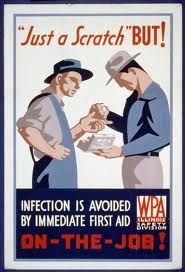
Many artists created posters for public health programs, tourism, and educational purposes. At the time Social Realism was the favored style and the WPA preferred figurative work rather than the newly developing genre of Abstract art. It was a challenge to some artists who were working in abstract art but the program also helped those artists develop and later to define the Abstract Expressionist era following WWII such as Jackson Pollock, Diego Rivera and Willem de Kooning.





Murals are probably the most recognized survivng results from the WPA program. Artists had to submit sketches and compete against eachother for the work. There were an estimated 2,566 murals commissioned by the federal government  mostly for post offices, but also schools and other government buildings around the country where they could be appreciated by everyone. Many of the murals were actually oil on canvas paintings afixed to the wall. One of the best known post office wall murals is "Woodsman in the Woods of Maine" by Waldo Peirce originally installed in the post office in Westbrook, Maine.

The painting, the whole wall - door and all - was removed from the Westbrook post office in 1980 when the building was demolished and is now residing in the Portland Museum of Art on loan from the U.S.Postal Service.

                    Another Maine mural in a school in Portland.

                              Mural in a library in Queens, NY

The FAP disbanded on June 30th, 1943. In December of that year the federal government auctioned off thousands of WPA funded artworks in a warehouse in Queens, NY. Paintings were sold by the pound, not individually. It is reported that a plumber purchased large quantities of the canvases in bulk for the purpose of insulating pipes but discovered when the pipes got hot the paint let off bad smells. Framers  also bought in quantity paying about $3.00 per canvas and acquiring some works by artists who later became famous after WWII such as Jackson Pollock.


Roosevelt's WPA put about 8.5 million people to work - about 1/5 of the nation's adults between 1935 and 1943. The FAP created over 100,000 paintings and 18,000 sculptures. These works of art are now turning 75 years old. For many years this work had been virtually ignored, not maintained very well, and even destroyed. The living history of this work is dying out leaving the artwork on it's own to speak for itself. Thankfully people are starting to realize what they have in their communities and are working to restore and preserve this work. If you are lucky enough to have a WPA mural in your community, go visit it and spend a few moments appreciating the artists who left the legacy for you and the governmental leaders who had the foresight  to give them the opportunity to create it.


Related Posts with Thumbnails