Rossetti was an eccentric with tendencies toward reclusiveness and depression. In art school he would rather immerse himself in translating medieval Italian poetry than practicing his drawing skills detesting the structure of study at the academy. His knowledge of other subjects such as science and theology was limited due to his singular focus on his own work and inspiration. His growing interest in women and his feminine ideal of beauty kept him from becoming a complete recluse. In 1848 Rossetti left the academy and together with William Holman Hunt developed the philosophy for the Pre-Raphaelite Brotherhood which they founded along with John Everett Millais. Rossetti was more interested in the medieval side of the movement rather than the modern. In 1850 Rossetti met Elizabeth Siddal who was to become an important artist's model for the brotherhood and in 1860 she became Rossetti's wife.
In both his painting and his poetry, Rossetti increasingly focused on mythological and symbolic images in his work rather than realistic ones. His medieval Arthurian visions inspired his friends William Morris and Edward Burne-Jones in their work too. He often wrote medieval inspired sonnets to accompany his paintings. Rossetti worked with William Morris to design stained glass windows and other decorative items.
In 1862 Rossetti's beloved wife, Elizabeth Siddall, died from an overdose of laudanum after giving birth to a stillborn daughter which precipitated a deep depression in the artist. He spent several years idealizing her image in his work. In Elizabeth Siddal, Rossetti's dream of the ideal woman first took hold for she embodied his fantasy of spiritual love and a blessed source for his own salvation. He drew and painted her incessantly seeing her virginity and pure sexuality as divine. When she posed for him gracefully, silently, his projections were fulfilled; Rossetti's imagination could fill out the rest of his perfect ideal woman. But when Lizzie spoke her mind even the great artist's imagination couldn't keep the dream from vanishing. In time Rossetti became sexually frustrated with Lizzie during their long 8 year engagement and his imaginings started to turn toward the not so spiritual kind of love. He came to prefer subjects of prostitution and the femme fatale, woman was no longer the salvation of man but man was now the savior of the fallen woman. In disparaging prostitution he could protect his fantasy of the ideal divine fair lady. In order to have any hope for salvation through spiritual love he had to keep the two types separate.

Lizzie Siddall

With the completion of these numerous and obsessively stylized yet soulful paintings, Rossetti became a major influence in the development of the European Symbolist movement. He had come to paint his fantasies from real life. Rossetti said he shut himself within his own soul, where he built his own imaginary world, and where creating art was merely a matter of copying his visions he saw there or expressions of his own soul. In these years Rossetti frequently employed his lover Fannie Cornforth and later his mistress Jane Burden Morris, wife of his business partner William Morris in glamorized compositions showing them as physically erotic or ethereally goddess-like women. About this time, he also discovered Alexa Wilding, a dressmaker, who was soon modeling for the artist on a full-time basis.

Fanny Cornforth as Helen of Troy, 1863
Fanny Cornforth came to personify the body's beauty in Rossetti's world. She was more overtly sexual than Lizzie was, less delicate, more voluptuous. Her image came to symbolize earthly beauty and physical pleasure or fantasy. Rossetti treated Fanny with condescension because of her lower status and lack of education. From his paintings it is apparent that he treated her more as an object than a person. She is usually shown straight forward, close up and looking the viewer right in the eye. There are no expressive, emotional or soulful qualities to her countenance. In reality Fannie was probably the most balanced and grounded of all Rossetti's women.

Jane Burden Morris as Proserpine, 1874
The third important muse in Rossetti's life was Jane Burden Morris. Rossetti knew Jane early on and understood her marriage to his friend and business partner William Morris was an unhappy one. Jane became indispensable to Rossetti after Lizzie Siddal Rossetti died in 1862. The two of them lived together for two years while William Morris traveled for business a great deal. Jane was different in appearance than Lizzie or Fanny having dark raven hair and a pale somber expression. She was also very tall. In most works Rossetti idealized his sitters to conform to his idealized vision of beauty but in Jane's case, it is said, he didn't have to idealize any feature for she was as beautiful as his vision. Whereas Lizzie was spiritual beauty and Fanny was physical beauty, Jane was a blending of the two. And as she was a bit aloof and remote, she was an empty canvas where Rossetti could depict her anyway he desired, in his own image or reflection. As it turned out, over time, he depicted her likeness with too many meanings as she came to mean too many things to him and that created an ambivalence for him.
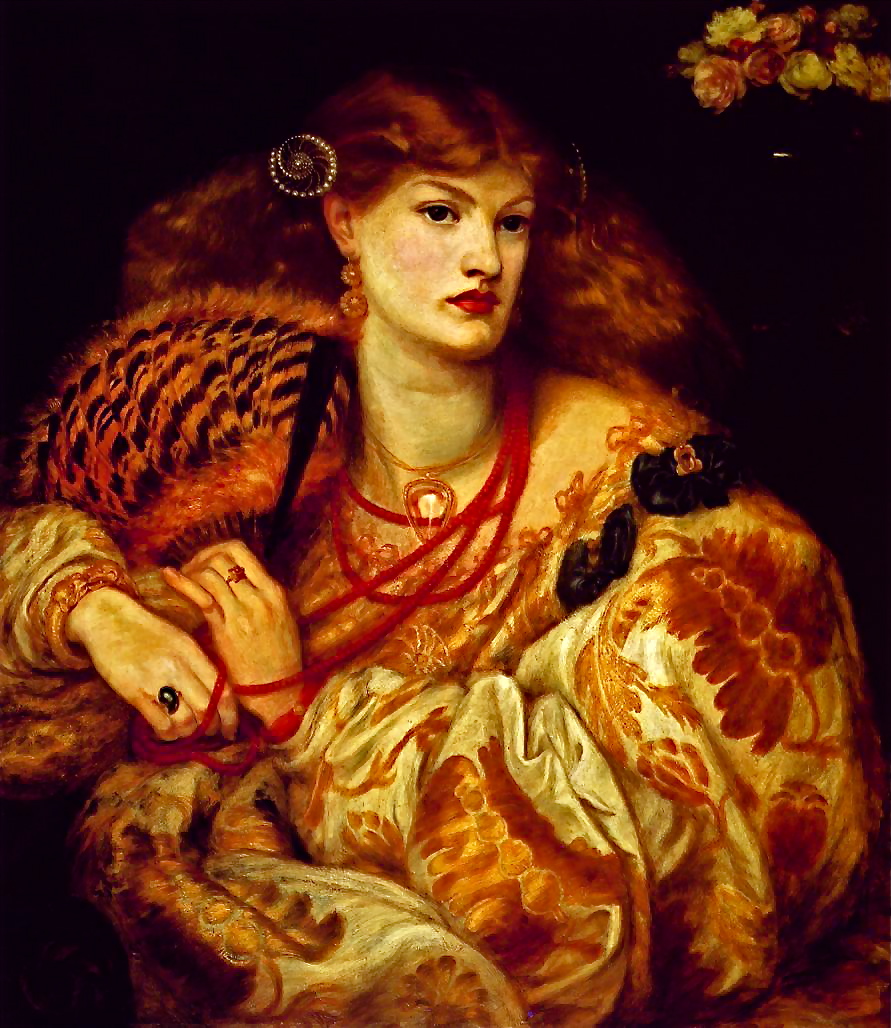
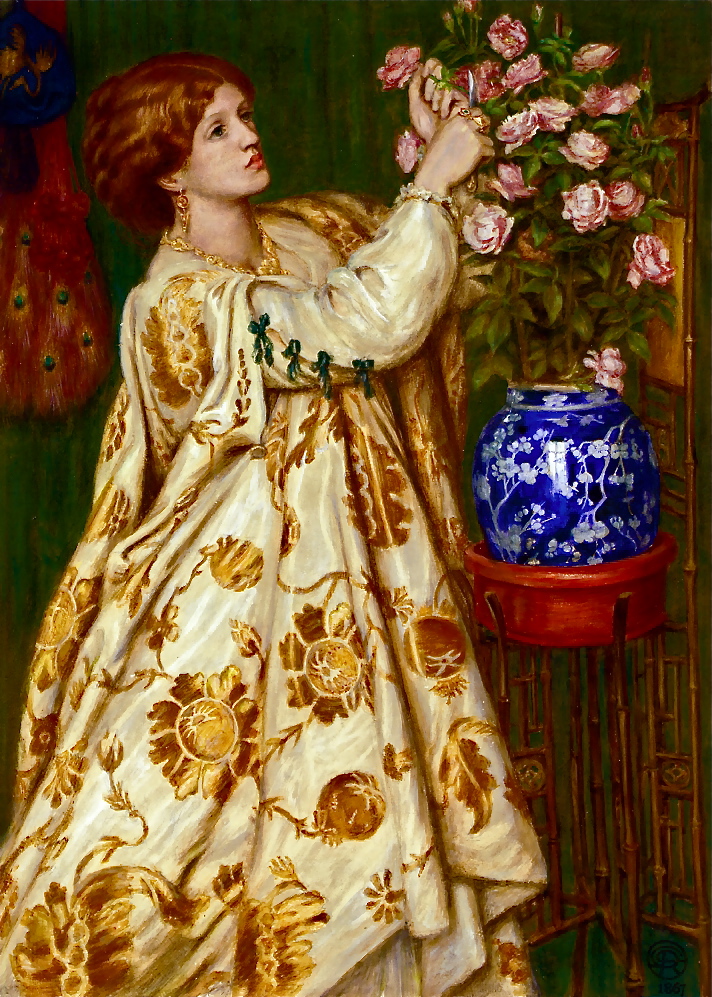
Alexa Wilding in Monna Vanna, 1866
Alexa Wilding was one of Rossetti's most frequent models from 1865 onward. They became loyal friends but were never lovers.


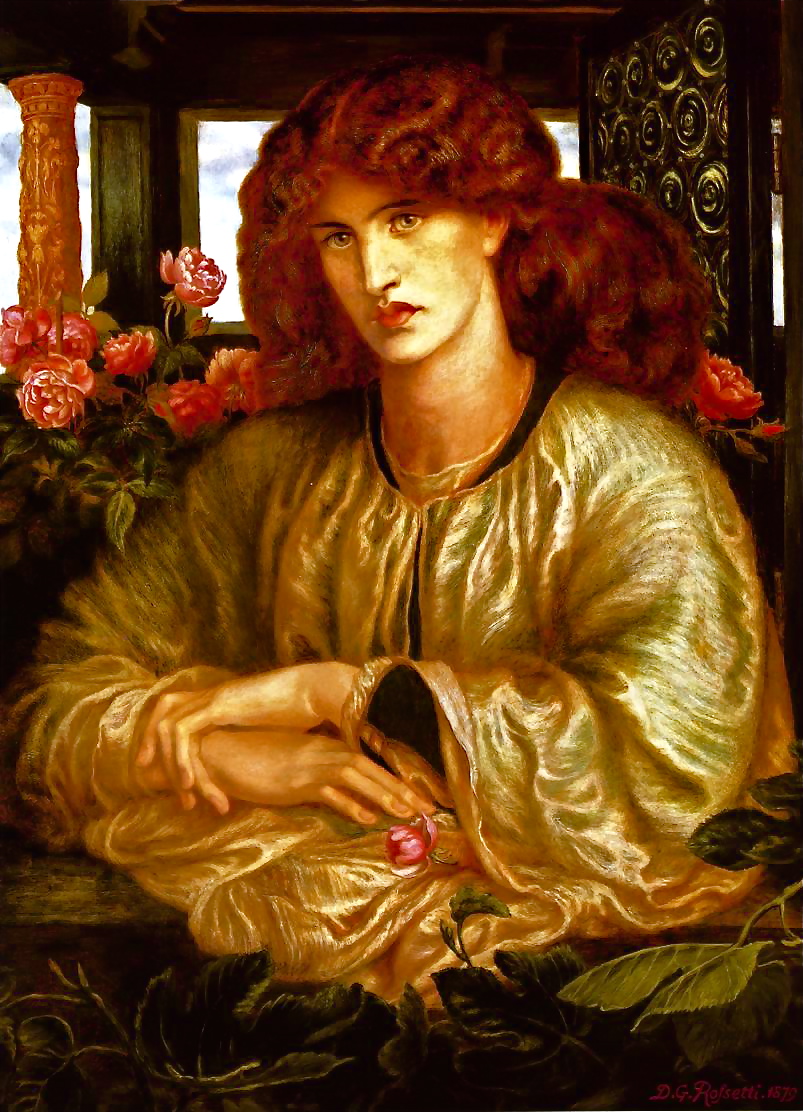
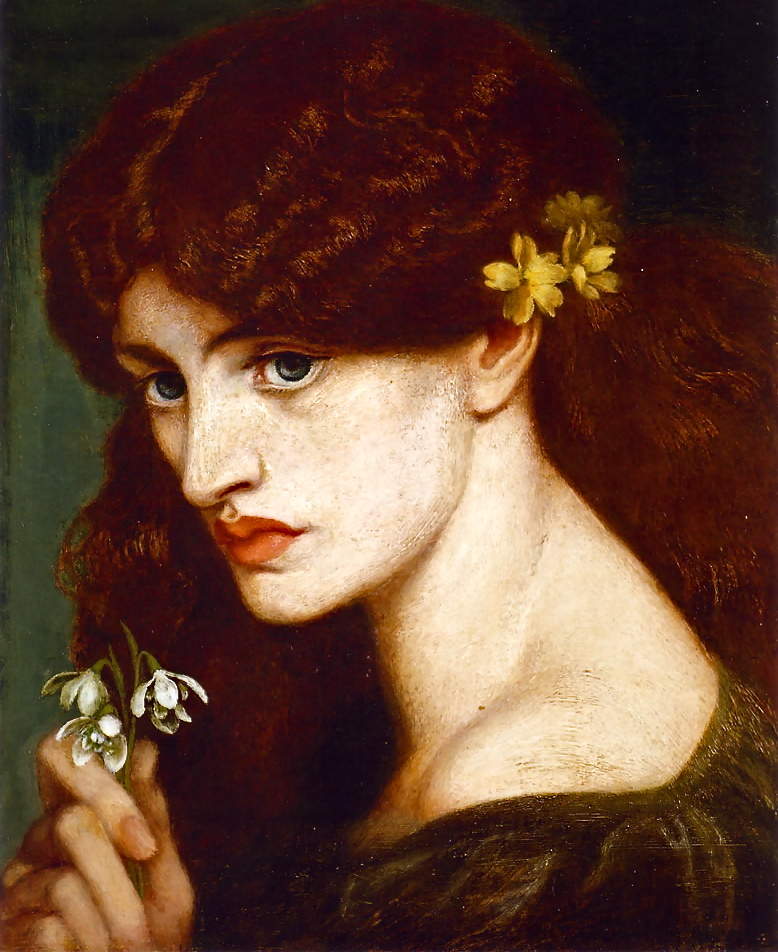


After receiving brutal criticisms of his first collection of poetry, Rossetti suffered a mental breakdown in June, 1872 and subsequently spent much of his time under the influence of his addictions to whiskey and chloral hydrate. The following summer he was much improved and completed a dream-like series of portraits of Jane Morris and Alexa Wilding. In 1874 William Morris cut Rossetti out of his decorative arts business and soon after Rossetti moved out of the house he rented with Jane Morris. In later years, he plunged further and further into the darkness of his dual addictions and mental illness. He died on Easter Sunday 1882 and is buried at Birchington-on-Sea, Kent, England.
(Information for this post gathered from Wikipedia and the Victorian Web.)





 Posts