Monday, November 22, 2010


Thursday, November 18, 2010
Letter in November by Sylvia Plath

Love, the world
Suddenly turns, turns color. The streetlight
Splits through the rat's tail
Pods of the laburnum at nine in the morning.
It is the Arctic,

This little black
Circle, with its tawn silk grasses - babies hair.
There is a green in the air,
Soft, delectable.
It cushions me lovingly.

I am flushed and warm.
I think I may be enormous,
I am so stupidly happy,
My Wellingtons
Squelching and squelching through the beautiful red.

This is my property.
Two times a day
I pace it, sniffing
The barbarous holly with its viridian
Scallops, pure iron,

And the wall of the odd corpses.
I love them.
I love them like history.
The apples are golden,
Imagine it ----

My seventy trees
Holding their gold-ruddy balls
In a thick gray death-soup,
Their million
Gold leaves metal and breathless.

O love, O celibate.
Nobody but me
Walks the waist high wet.
The irreplaceable
Golds bleed and deepen, the mouths of Thermopylae.

Sylvia Plath 1932-1963
Friday, November 12, 2010
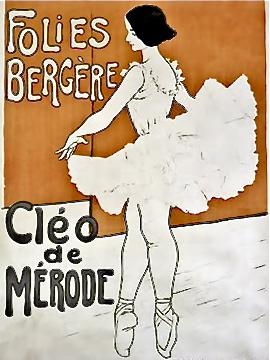
Cleo de Merode, Beauty of le Belle Epoque
She was born Cleopatra Diane de Merode in Bordeaux, Paris, France in 1874. She was the daughter of Karl von Merode, an Austrian landscape painter belonging to a famous Belgian noble family de Merode. Nicknamed "Cleo", she was selected for the Opera School of Dance when she was only 8 years old, at 11 she was dancing professionally, and at 13 she was chosen to dance in the prestigious ballet, Choryhee. It was then that she started to wear her hair pulled back in the chignon style with the hair covering her ears which became the talk of Paris and a popular style for many women. Her image was captured on post cards and playing cards which were widely collected.

She quickly became a favorite of many artists of the time including Toulouse-Lautrec, Gustav Klimt, Edgar Degas and Alexandre Falguiere. The ballerina performed in many major cities including St. Petersburg, New York and London but was probably more famous for her beauty than her dancing.


In 1896, King Leopold II of Belgium attended the ballet and it is recounted how he became enamored with the 23 year old dancer. At the time the king was 61. Ballerinas were regarded almost as courtesans in Paris at the time. The Paris Opera was said to have been called a "national harem". Gossip spread among Parisians about de Merode being the king's new mistress, so much so that the king became dubbed King Cleopold. Such accusations were strongly denied by de Merode but the scandal followed her throughout her life. Outraged, Cleo de Merode left Paris to dance internationally in such cities as Hamburg, Berlin, St. Petersburg, Budapest and New York. In the Russian Ballet she became the first ballerina to dance with a male partner.


At the peak of her ballet career, Cleo elected to perform with the Folies Bergere, something no other ballet elite would do. The risk she took gained her a whole new following. At age 42, Cleo returned to her birthplace of Biarritz, never to return to Paris. She still continued to dance, performing through the Red Cross for the wounded soldiers during WWI.

She is reported to have had only two relationships with men in her life, both long term. The first, an aristocrat lasted ten years until he died of typhoid fever; the second, a Spanish diplomat and sculptor eventually left her for another woman. Cleo de Merode died in 1966 at the age of 91 and is interred in the Pere Lachaise Cemetery in Paris.


In 1896, King Leopold II of Belgium attended the ballet and it is recounted how he became enamored with the 23 year old dancer. At the time the king was 61. Ballerinas were regarded almost as courtesans in Paris at the time. The Paris Opera was said to have been called a "national harem". Gossip spread among Parisians about de Merode being the king's new mistress, so much so that the king became dubbed King Cleopold. Such accusations were strongly denied by de Merode but the scandal followed her throughout her life. Outraged, Cleo de Merode left Paris to dance internationally in such cities as Hamburg, Berlin, St. Petersburg, Budapest and New York. In the Russian Ballet she became the first ballerina to dance with a male partner.


At the peak of her ballet career, Cleo elected to perform with the Folies Bergere, something no other ballet elite would do. The risk she took gained her a whole new following. At age 42, Cleo returned to her birthplace of Biarritz, never to return to Paris. She still continued to dance, performing through the Red Cross for the wounded soldiers during WWI.


Tuesday, November 9, 2010
Another young beauty from le Belle Epoque!
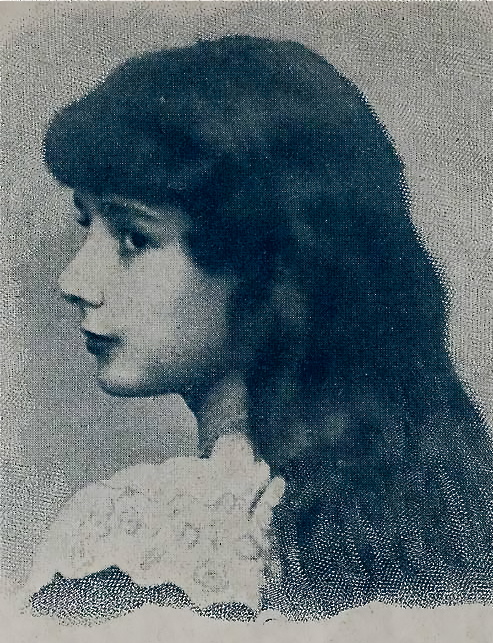
Who was she? She was born in Paris in 1874 of Austrian descent.


Sunday, November 7, 2010
Burning Leaves

Burning Leaves, November
THESE are the folios of April,
All the library of spring,
Missals gilt and rubricated
With the frost's illumining.
Ruthless, we destroy these treasures,
Set the torch with hand profane--
Gone, like Alexandrian vellums,
Like the books of burnt Louvain!
Yet these classics are immortal:
O collectors, have no fear,
For the publisher will issue
New editions every year.
Christopher Morley


November Night
LISTEN . . .
With faint dry sound,
Like steps of passing ghosts,
The leaves, frost-crisp'd, break from the trees
And fall.
Adelaide Crapsey
Friday, November 5, 2010
Home, A new Melange Team ETSY challenge
It's been a while since I did one of these challenges. It is certainly quicker and easier if you can do it in Photoshop. This week's challenge is on the word "home". This is my submission piece.


Monday, November 1, 2010
November by Walter de la Mare

There is wind where the rose was,
Cold rain where sweet grass was,
And clouds like sheep
Stream o'er the steep
Grey skies where the lark was.
Nought warm where your hand was,
Nought gold where your hair was,
But phantom, forlorn,
Beneath the thorn,
Your ghost where your face was.
Cold wind where your voice was,
Tears, tears where my heart was,
And ever with me,
Child, ever with me,
Silence where hope was.
Walter de la Mare


Subscribe to:
Posts (Atom)


 Posts