Friday, March 15, 2013
A Dryad for St. Paddy's Day!
My latest digital art piece stirs deep ancestral memories of an earlier time and place. A celebration of green just in time for St. Paddy's Day! Happy St. Patrick's Day! Lá Fhéile Pádraig Sona Daoibh!


Thursday, March 7, 2013
Come Hither Child by Emily Jane Bronte

Come hither, child--who gifted thee
With power to touch that string so well?
How darest thou rouse up thoughts in me,
Thoughts that I would--but cannot quell?
Nay, chide not, lady; long ago
I heard those notes in Ula's hall,
And had I known they'd waken woe
I'd weep their music to recall.
But thus it was: one festal night
When I was hardly six years old
I stole away from crowds and light
And sought a chamber dark and cold.
I had no one to love me there,
I knew no comrade and no friend;
And so I went to sorrow where
Heaven, only heaven saw me bend.
Loud blew the wind; 'twas sad to stay
From all that splendour barred away.
I imaged in the lonely room
A thousand forms of fearful gloom.
And with my wet eyes raised on high
I prayed to God that I might die.
Suddenly in that silence drear
A sound of music reached my ear,
And then a note, I hear it yet,
So full of soul, so deeply sweet,
I thought that Gabriel's self had come
To take me to thy father's home.
Three times it rose, that seraph strain,
Then died, nor breathed again;
But still the words and still the tone
Dwell round my heart when all alone.
Sunday, February 24, 2013
My Latest Collage Listings on ETSY!


Collage artwork as seen in my ETSY art shop at:
https://www.etsy.com/shop/MaureenTillman?ref=si_shop
Thursday, February 7, 2013
I Am by John Clare
I am! yet what I am none cares or knows, My friends forsake me like a memory lost; I am the self-consumer of my woes, They rise and vanish in oblivious host, Like shades in love and death's oblivion lost; And yet I am! and live with shadows tost Into the nothingness of scorn and noise, Into the living sea of waking dreams, Where there is neither sense of life nor joys, But the vast shipwreck of my life's esteems; And e'en the dearest—that I loved the best— Are strange—nay, rather stranger than the rest. I long for scenes where man has never trod; A place where woman never smil'd or wept; There to abide with my creator, God, And sleep as I in childhood sweetly slept: Untroubling and untroubled where I lie; The grass below—above the vaulted sky.  (copyright Maureen Kavaney Tillman 2013) | |
Wednesday, January 30, 2013
Lines: The Cold Earth Slept Below by Percy Bysshe Shelley

The cold earth slept below;
Above the cold sky shone;
And all around,
With a chilling sound,
From caves of ice and fields of snow
The breath of night like death did flow
Beneath the sinking moon.
The wintry hedge was black;
The green grass was not seen;
The birds did rest
On the bare thorn’s breast,
Whose roots, beside the pathway track,
Had bound their folds o’er many a crack
Which the frost had made between.
Thine eyes glow’d in the glare
Of the moon’s dying light;
As a fen-fire’s beam
On a sluggish stream
Gleams dimly—so the moon shone there,
And it yellow’d the strings of thy tangled hair,
That shook in the wind of night.
The moon made thy lips pale, beloved;
The wind made thy bosom chill;
The night did shed
On thy dear head
Its frozen dew, and thou didst lie
Where the bitter breath of the naked sky
Might visit thee at will.


Friday, January 4, 2013
William Adolphe Bouguereau, 1825 - 1905

William Adolphe Bouguereau was born in 1825 in La Rochelle, France into a family of wine and olive oil merchants. As a young man he put himself through the Ecole des Beaux - Arts academy by bookkeeping for the family business, painting portraits and coloring lithographic labels for a grocer. This early training in discipline and perseverence benefited him in his artistic life during which he produced a total of 826 finished works earning him immense public acclaim and financial success. He was serious and industrious in his work mastering the history of his subject before working on numerous detailed pencil and oil sketches, and only then did he begin a painting. His careful study and painstaking work produced beautifully accurate renderings of the human form, especially in the hands and feet which are notoriously difficult to render well. His mastery of them marks Bouguereau as a highly skilled academic painter.
( Personally, I spent many years painting portraits and figures and I can attest to how beautifully Bouguereau executes the hands and feet of his subjects. It's what drew me to his work originally. )


In 1856 William married Marie-Nelly Monchablon and over time they had 5 children, 3 sons and 2 daughters. By the late 1850s Bougeaureau was well connected with influential art dealers and his fame extended to England, Germany, Belgium, Spain, the Netherlands and America. He was commissioned frequently to decorate private homes, public buildings, and churches with his paintings. He was also a very successful portrait painter of his wealthy patrons. He gained many honors of the Academy and began teaching at the Academie Julian in 1875.


In his private life, William's infant daughter died in 1872. His son Georges died in 1875 at the age of 16. Then in 1877 his wife died, followed in 2 months by another infant son. His third son died in 1900. By the end of 1877 William wanted to marry his pupil, the American artist, Elizabeth Jane Gardner. But William's mother who lived with him and ran his household forbid the union. His remaining daughter also was against them marrying so soon after the death of her mother. So the couple decided to wait it out until his mother passed but she survived to be 91, dying in the year 1896. So that year, at the age of 71, William Bouguereau wed Elizabeth Jane Gardner. He used his influence to open many French art institutions to women students for the first time. Bouguereau and Elizabeth only had eight years together when William died in 1905 in La Rochelle, France at the age of 79 of heart disease.

'A Soul Brought to Heaven' was completed while Bouguereau was still in mourning for his wife. There were other pieces done at this time also as memorials to his deceased wife and children.
After 1920 Bouguereau's work fell into disrepute due to changing tastes and his opposition to the Impressionists who were gaining attention and acceptance. For decades after, his name was not even mentioned in encyclopedias. By the time of his death in 1905, he was one of the most reviled of French artists by the avant-garde and major critics of the period and by progressive painters some soon to be known as the Impressionists. The rancor he experienced was because he painted as a traditionalist in the realistic Academic genre influenced by classical literature and the Italian Renaissance style of Raphael and the ancients. Both the Pre-Raphaelites and the Impressionists, both art reform movements of the period rejected the conventional classical style long admired in the French Acadamie society


So although Bouguereau's work fell into obscurity for a time with museum curators and art experts, he remained a favorite of collectors who always appreciated the beauty of his work. Besides his commission pieces which were very large and thus not easily sold except through commissions, he did religious work many with angels and cherubs, and pastoral portraits of sheperdesses. These smaller pieces appealed to the middle class who had begun desiring original artworks in their homes like the wealthier buyers. Most of his subjects were women and children who Bouguereau regularly beautified while retaining their likemess.


In 1974 the New York Cultural Center staged a show of Bouguereau's work as a curiosity. Others soon followed and in 2005 the J. Paul Getty museum exhibited just 3 of his paintings and soon tens of thousands were waiting in line to see his work.


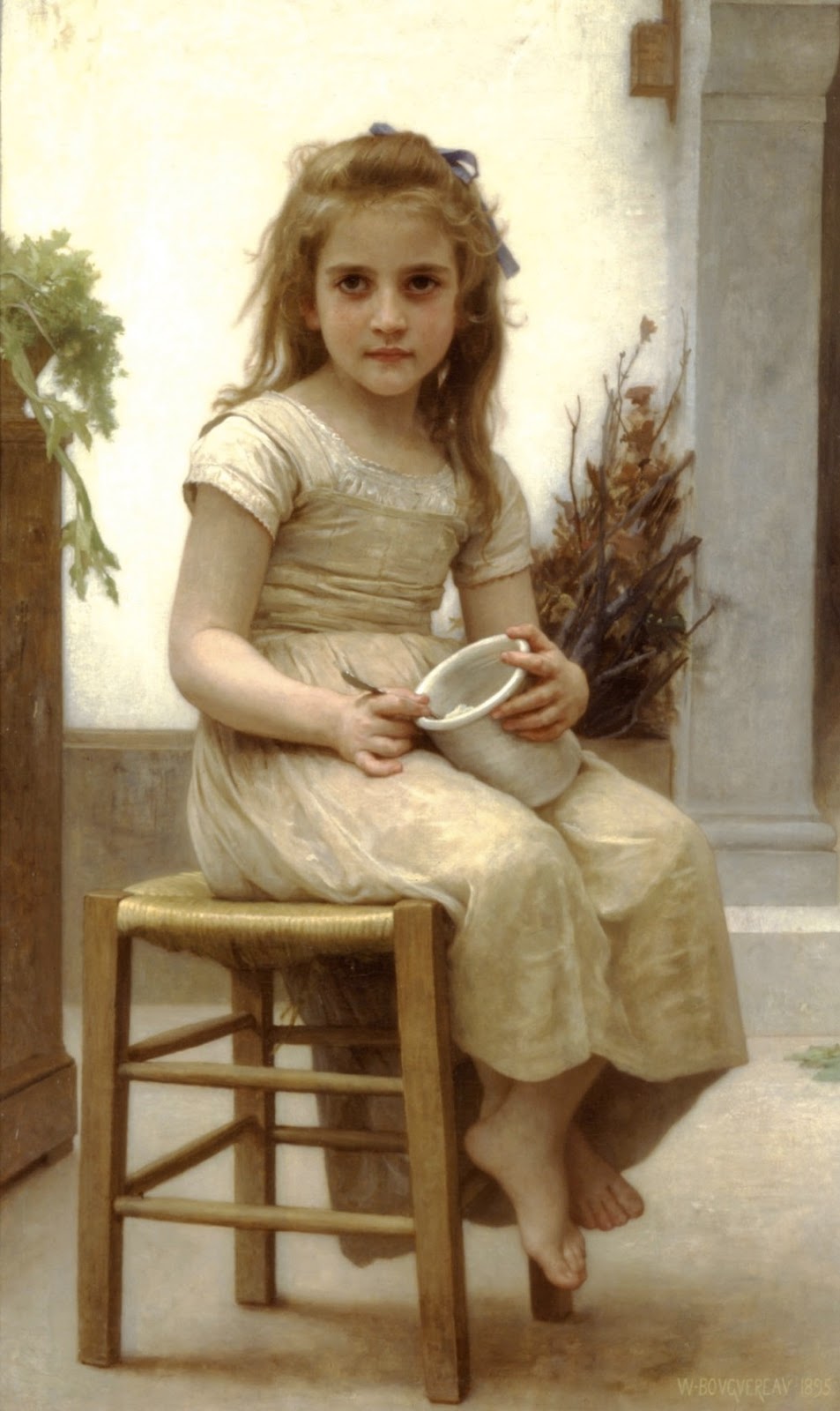


Since 1960, his values in the market place have doubled basically every 3.5 years. From works selling from $500 to $1500 in 1960, to in 1998 The Heart's Awakening sold for $1,410,000, in 1999 Cupid et Psyche, Enfants sold for $1,760,000 and Alma Perens sold for $2,650,00 that same year and in May of 2000 Charite sold for $3,520,000. Over the past 20 years his paintings have been taken out of their crates, basements, storage rooms and attics all over the world cleaned and some restored and now over a hundred museums and institutions world-wide have his works on permanent exhibit to much acclaim.
Monday, December 31, 2012
To the New Year by W.S. Merwin

With what stillness at last
you appear in the valley
your first sunlight reaching down
to touch the tips of a few
high leaves that do not stir
as though they had not noticed
and did not know you at all
then the voice of a dove calls
from far away in itself
to the hush of the morning
so this is the sound of you
here and now whether or not
anyone hears it this is
where we have come with our age
our knowledge such as it is
and our hopes such as they are
invisible before us
untouched and still possible


Subscribe to:
Posts (Atom)





 Posts